How to Avoid Getting Your WhatsApp Account Banned
Good practices!
We created this topic to share a little bit of what we learned about good practices with the intention of avoiding the nuisance of being blocked or banned on WhatsApp.
We would like to start by sharing the following reflection with you, it is very probable that you receive various messages in a day, those being sent by stores, promotions, telemarketers and so on. Now think, just through WhatsApp how many of those messages do you recieve? Probably none or very few isn’t that true? Even with that being the case WhatsApp allows you to mark those messages as spam and lets you block those numbers and contacts.
WHATSAPP DOESN’T ALLOW SPAM
WhatsApp is very rigorous when the topic is about sending spam and that is why we pay more attention to them than regular SMS messages. Why is it that we let various texts accumulate and yet we just can’t keep ourselves from looking at our phone when someone sends us a WhatsApp? Because we know that we rarely receive spam on WhatsApp and we know it will most likely be someone that we know trying to get into contact and rarely does someone we know send us promotions or things alike.
How many messages can i send?
Quantity is something very important, however it is not about how many messages you can send. The key is all about WHO CAN I send many messages to
We always use the same case of the oldest client we have, Who today sends promotional messages to more than 80 thousand people daily and has never had his number blocked. When we talked to him and asked about how he was pulling this off, he kindly shared the following techniques:
- First: To receive messages about promotions the recipient needs to add the company’s number as one of their contacts and send them a message saying “i want promotions”. This simple actions significantly lowers the chances of being blocked because with his number in our agenda and starting the conversation the buttons displayed for blocking and marking as spam do not show;
-
Second: He personalizes the texts with information from the recipient, so the messages won’t be exactly the same;
-
Third: Always give them an option to stop receiving the messages. Example: “type 2 to stop receiving messages”. With this he monitors the webhooks making sure he takes out any of the numbers that do not wish to receive anymore messages.
-
Fourth: He only sends messages through his broadcast list
Resumo
-
Avoid sending messages to people who aren’t in your contacts list.
-
Personalize messages with information from your recipient. In case that is not possible, use random attributes to make each message different.
-
try to convince the recipient to interact with your number. Especially if you know he doesn’t have your number saved in his contacts list.
-
Offer an option for them to not receive anymore messages and monitor your webhooks to be able to treat those interactions and..
-
If possible only send messages through your broadcast list.
Warning
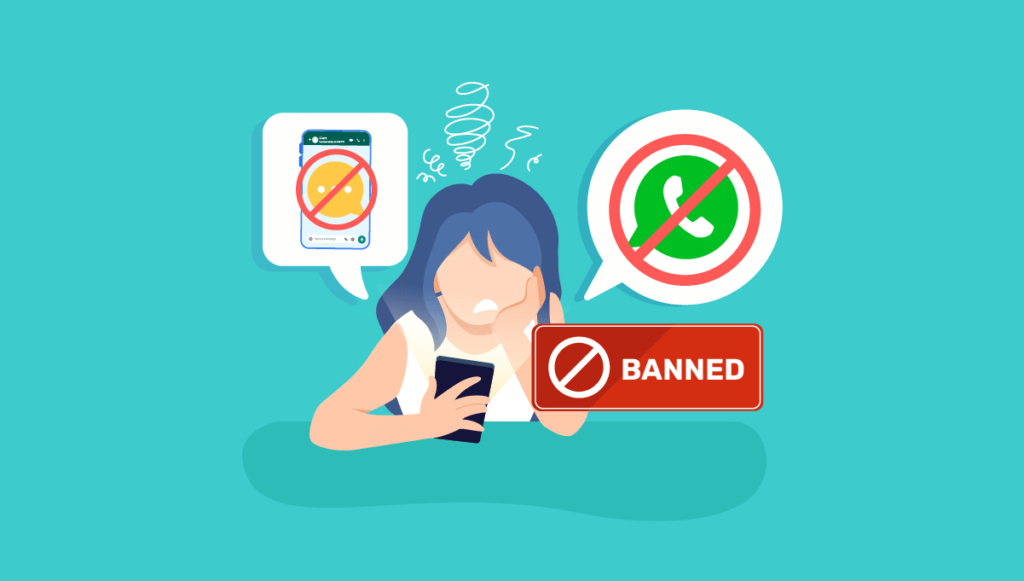
If only 3% of your recipients mark your messages as spam your number will be banned!!!
The discussion about WhatsApp bans involving IPs, ASNs, and phone numbers is complex and involves multiple variables. Over the past four years, we have conducted various tests using both WhatsApp Web (QR Code generator) and the device connected to this QR Code.
What we have learned during this period is that, while IP and ASN have some relevance, they are not the main factors determining a ban. We have implemented an IP rotation strategy in 15, 30, 45, and 60-day cycles, and this isolated action has not shown a significant impact in reducing blocks.
Key Factors Influencing Bans
1. Global Events and Fake News Volume
High-profile media events, such as elections, political crises, and the spread of fake news, directly impact the ban rate. Whenever there is a major media event, we observe a percentage increase in the number of banned accounts, regardless of IP, ASN, or connection method. This suggests that WhatsApp intensifies moderation during these periods.
2. Message Content and Sensitive Keywords
WhatsApp has an advanced algorithm that analyzes content patterns. Messages with content of exclusive interest to the sender (i.e., those that do not generate natural interactions) are subject to scrutiny.
Financial topics carry a higher risk of blocking, especially when they include keywords such as “boleto,” “PIX,” “card,” and others associated with financial scams. The recurrence of these words can trigger automatic verification mechanisms, increasing the risk of restrictions.
3. Use of Recent Numbers and Bulk Messaging
New numbers sending messages to many different recipients in a short period are easily flagged as suspicious. This behavior can be simulated directly within the WhatsApp app, without the need for APIs or external platforms. Several reports indicate that newly activated numbers are being banned quickly, even without using automated tools.
4. Number Recycling and Usage History
The high turnover of recycled numbers can be either beneficial or harmful, depending on the number’s history. If the number was previously used for suspicious activities, it may be banned shortly after scanning the QR Code or after sending a small volume of messages.
5. Message Volume vs. Number of Recipients
The most relevant factor in determining a ban is the number of unique recipients, rather than just the total number of messages sent. The more different contacts a number tries to reach in a short period, the higher the likelihood of being classified as spam.
6. Reusing Patterns in Replacement Numbers
A common practice after a ban is setting up a new number in exactly the same way as the previous one. WhatsApp can detect this, especially if the new number retains the same name, photo, description, and messaging patterns.
To mitigate this risk, it is recommended to:
- ✅ Change the profile picture before activating the number.
- ✅ Modify the description and contact name before starting usage.
- ✅ Make slight adjustments to the initial sending behavior to avoid repetitive patterns. These actions can help prevent WhatsApp from associating the new number with the previously banned one, reducing the risk of an immediate block.
Tests and Comparison with Previous Years
We have conducted tests using both the official WhatsApp API and the web version. Surprisingly, in many cases, simply connecting a new number to the platform can trigger a ban. Additionally, there are instances where a block occurs after sending just 10 messages to different recipients.
Compared to previous years, the ban rate remains relatively stable, but the impact varies among clients. Some industries are experiencing higher bans than others, which may be directly linked to message content and recipient profiles.
Conclusion: What Really Matters?
WhatsApp’s algorithm changes constantly, making it impossible to rely on a single foolproof strategy to avoid bans. In the past, it was easier to claim that “passive accounts are not banned” and that “highly active accounts are,” but today, this distinction is no longer as clear.
The two main factors that determine bans are:
- ✅ The number of different recipients a number tries to reach.
- ✅ Message content (keywords, context, and sending pattern). Secondary factors, such as number history, IP/ASN, and connection method (Web or Official), still have an impact but are less decisive than the factors above.
There is no 100% effective best practice for avoiding bans. WhatsApp’s algorithm is becoming increasingly dynamic, and the only viable approach is to monitor, continuously adapt strategies, and operate within the platform’s acceptable limits.